




The Calculus of the Arcane: Interacting with Magic Through Science and Math
In most Dungeons & Dragons games, magic is treated as mystical: whispered incantations, ancient tomes, and inscrutable forces beyond mortal comprehension. But what if magic isn’t unknowable—just complex?
What if magic behaves less like a miracle… and more like physics?
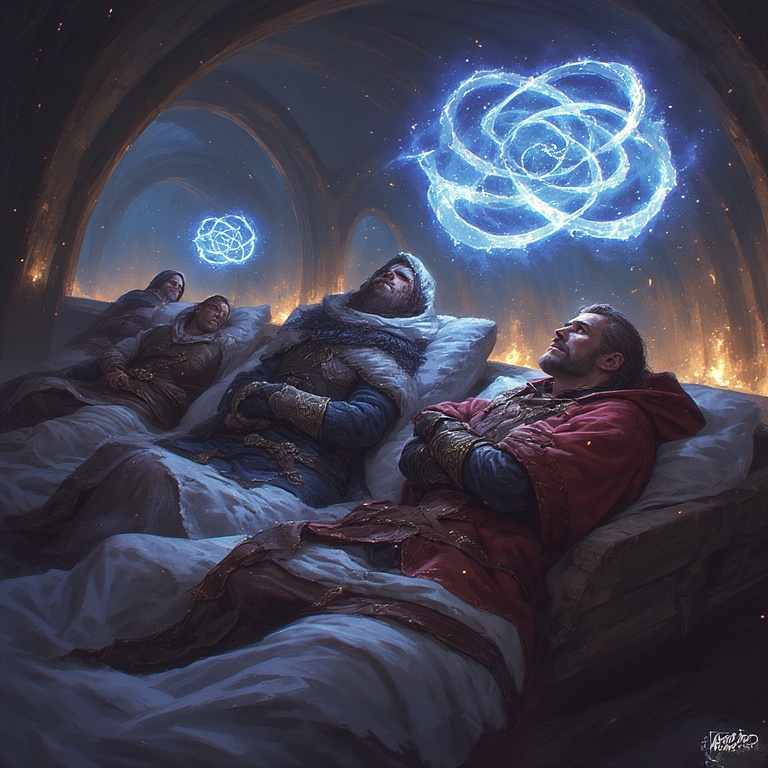
By reframing magic as a system with rules, flows, and measurable properties, players and Dungeon Masters can unlock a powerful new layer of flavor. This approach doesn’t remove wonder— it relocates it, turning spellcasting into arcane engineering, magical ecology, and cosmic mathematics.
Let’s explore how science- and math-inspired thinking can deepen your game world and empower creative play.
Magic as a Field, Not a Force
In physics, forces don’t act randomly—they propagate through fields. Gravity, electromagnetism, and even quantum probability all exist everywhere, influencing matter based on local conditions.
Magic can work the same way.
Instead of spells “creating” magic, imagine that spellcasters interact with a preexisting magical field:
-
The Weave is a scalar field with varying intensity
-
Ley lines are regions of high magical flux
-
Dead magic zones are areas where the field collapses or decoheres
From this perspective, a wizard isn’t summoning fire from nowhere—they’re shaping a localized spike in arcane energy density until reality undergoes a phase change (also known as fireball).
DM Flavor Hook
Describe spellcasting as tuning or aligning with ambient magic:
“You feel the field resist at first, like pushing against a current—but once aligned, the spell snaps into place.”
Spellcasting as Applied Mathematics
Magic may feel emotional or instinctual, but behind the scenes it can be deeply mathematical.
Wizards: Calculators of Reality
Wizards treat spells as equations:
-
Runes are symbolic notation
-
Somatic gestures define vectors and orientation
-
Verbal components set boundary conditions
A spellbook isn’t just lore—it’s a notebook of proven models. Preparing spells is choosing which formulas you’ve memorized well enough to solve under pressure.
A miscast spell isn’t a failure of will—it’s a rounding error.
Sorcerers: Chaotic Systems
Sorcerers operate like nonlinear dynamics:
-
Small emotional changes produce massive effects
-
Metamagic is real-time parameter adjustment
-
Wild Magic is a chaotic attractor you occasionally fall into
They don’t calculate the equation—they are the equation.
Clerics & Warlocks: External Computation
These casters outsource the math:
-
Deities and patrons act as black-box processors
-
The spell works, but the underlying proof is hidden
-
Occasionally, the “server” has opinions
Conservation of Magical Energy
One of the most useful scientific metaphors for DMs is conservation.
Energy is never created or destroyed—only transformed. What if magic follows a similar rule?
-
Healing transfers vitality from the field into flesh
-
Necromancy reassigns existing life energy
-
Massive rituals drain regions, causing long-term consequences
This explains:
-
Why overused magical areas become unstable
-
Why ancient battlefields feel “haunted”
-
Why archmages are careful about repeated large spells
Optional Worldbuilding Rule
Every major spell leaves an arcane footprint. Detect Magic doesn’t just see spells—it reads lingering gradients like heat maps.
Probability, Statistics, and Dice
D&D already uses math—lean into it in-world.
Critical hits? Statistical outliers.
Advantage? Improved signal-to-noise ratio.
Divination magic? Bayesian inference using cosmic data sets.
A diviner isn’t seeing the future—they’re sampling probable timelines and collapsing uncertainty.
“The augury doesn’t say what will happen—only which outcome has the highest likelihood given current conditions.”
This framing helps DMs justify vague prophecies while making them feel internally consistent.
Player-Facing Flavor: How to Use This at the Table
For Players
-
Describe spells as manipulations, not incantations
-
Ask questions like:
-
“What’s the ambient magical density here?”
-
“Can I redirect the flow instead of overpowering it?”
-
-
Roleplay preparation as study, calibration, or mental modeling
A wizard might say:
“This chamber resonates at a harmonic frequency perfect for illusion magic—I’ll amplify it.”
For Dungeon Masters
-
Reward creative interaction with magical environments
-
Let Arcana checks reveal mechanics, not just lore
-
Treat magic-heavy locations like ecosystems or reactors
Instead of “the spell fails,” try:
“The local field is saturated—casting here risks destabilization.”
Why This Makes Magic Feel More Magical

Paradoxically, giving magic structure doesn’t make it mundane—it makes it vast.
Players stop asking:
“Can I cast this spell?”
And start asking:
“What happens if I do?”
Magic becomes:
-
A natural phenomenon with awe-inspiring scale
-
A tool that demands respect
-
A system clever players can learn to dance with
Just like real science, the deeper you go, the more mystery you uncover.
Final Thought: Wonder Through Understanding
In the real world, knowing how stars burn doesn’t make them less beautiful—it makes them more astonishing.
Treating magic as a science of the impossible invites players to engage with your world intellectually, creatively, and emotionally. It gives spellcasters identity, DMs narrative tools, and everyone a shared language for awe.
After all, any sufficiently analyzed magic is indistinguishable from a really good story.
Thanks for reading. Until Next Time, Stay Nerdy!!



No Comments